
For specialist IT services and SaaS, every relevant search is an opportunity to reach a potential customer. Iphos tested the performance-focused SEA approach behind LastLayer to turn AI-generated ad copy into content designed for specific keywords and landing pages, with experts reviewing the final ads.
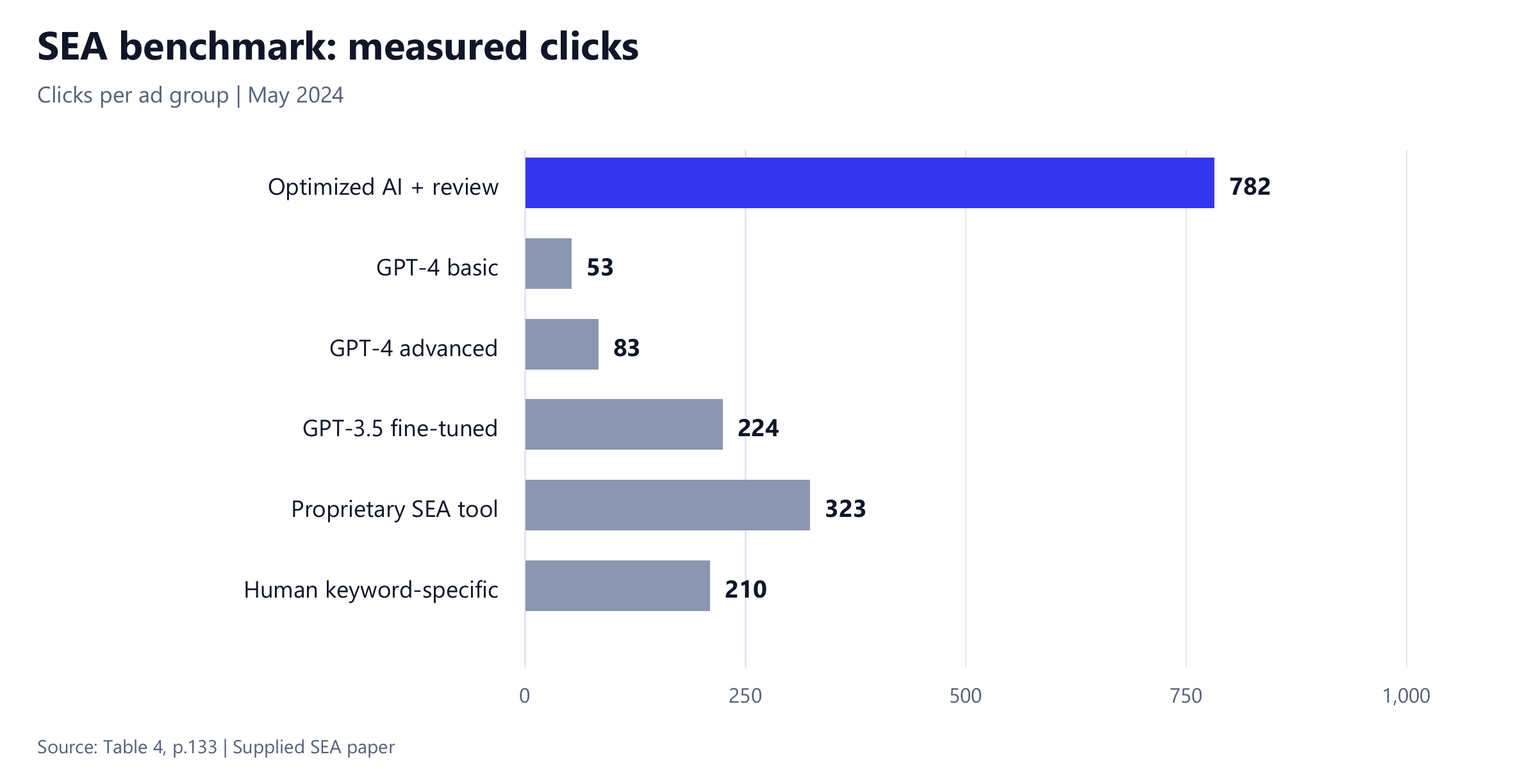
The May 2024 benchmark delivered 782 measured clicks, compared with 210 for human-written keyword-specific ads and 323 for the proprietary SEA generator. The result: more campaign exposure and more visits from paid search.
Performance-focused SEA content
Iphos operates in a specialist B2B market where relevant searches can be scarce. The challenge was to create keyword-specific ads at scale and give those ads a better chance of being shown and clicked.
The workflow combined target keywords, search context and landing-page information to generate, evaluate and select ad text. SEA experts reviewed the selected copy before launch. This gave the team a repeatable route from AI draft to campaign-ready content while retaining editorial control.
The commercial benchmark
Six ad-writing approaches were tested for one month in May 2024, with 19 keywords per group and a shared campaign cap of EUR 20 per day. Optimized AI ads achieved the highest impression and click counts of the tested groups.
| Ad content | Impressions | Clicks | Est. conv. | Median CPC |
|---|---|---|---|---|
| Optimized AI + expert review | 14,226 | 782 | 16 | EUR 0.37 |
| GPT-4 basic prompting | 824 | 53 | 1 | EUR 0.33 |
| GPT-4 advanced prompting | 1,159 | 83 | 2 | EUR 0.33 |
| GPT-3.5 fine-tuned | 4,006 | 224 | 4 | EUR 0.37 |
| Proprietary SEA generator | 5,973 | 323 | 6 | EUR 0.36 |
| Human keyword-specific | 4,611 | 210 | 4 | EUR 0.34 |
Table 4, p.133. Clicks and impressions were measured; all Iphos conversion counts are estimates based on historical conversion information. CPC is the median across ads and keywords. Shared campaign budgets do not mean equal spend per group.
The optimized group produced 3.7x the clicks of human-written ads and 2.4x the clicks of the proprietary generator. Its median CPC was EUR 0.37, compared with EUR 0.34 for human-written ads: the business gain in this test was more traffic, rather than a lower price per click.
SEA performance across campaign budgets
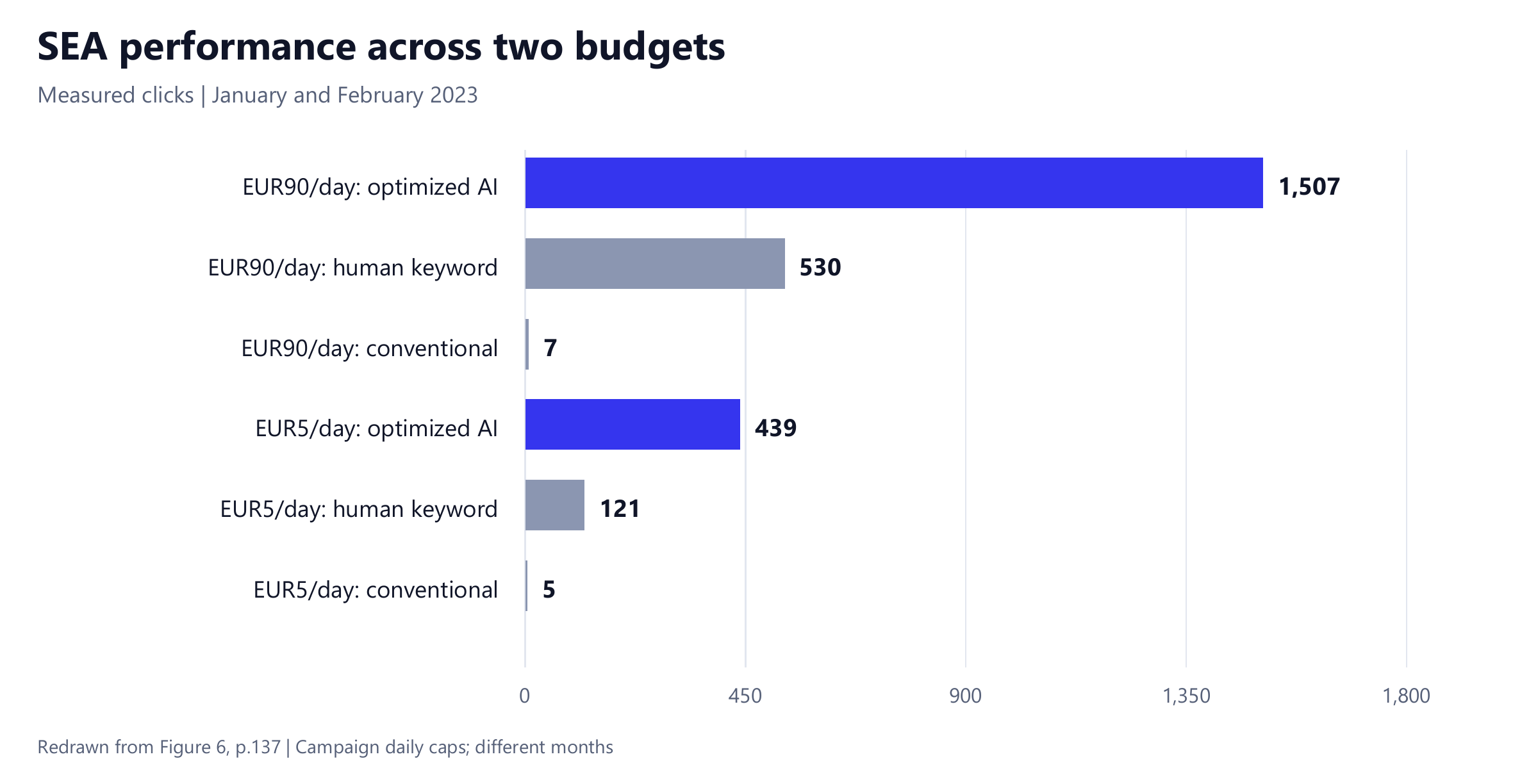
The original campaign compared AI-reviewed copy with two human-written approaches. In January 2023, the campaign cap was EUR 90 per day; in February, it fell to EUR 5 per day. The AI group retained its click advantage at both budget levels.
| Campaign / content | Impressions | Clicks | Est. conv. | Median CPC |
|---|---|---|---|---|
| EUR 90/day: Optimized AI + expert review | 34,590 | 1,507 | 30 | EUR 0.29 |
| EUR 90/day: Human keyword-specific | 12,031 | 530 | 10 | EUR 0.26 |
| EUR 90/day: Human conventional | 1,255 | 7 | 0 | EUR 0.38 |
| EUR 5/day: Optimized AI + expert review | 11,257 | 439 | 9 | EUR 0.15 |
| EUR 5/day: Human keyword-specific | 4,866 | 121 | 2 | EUR 0.15 |
| EUR 5/day: Human conventional | 364 | 5 | 0 | EUR 0.10 |
Figure 6, p.137, redrawn from the reported counts. Different months and campaign caps are shown. Total spend across all ad groups was EUR 875 in January and EUR 122 in February.
At the lower budget, optimized AI ads delivered 439 clicks versus 121 for human-written keyword-specific ads, with the same EUR 0.15 median CPC. Lower spending reduced total traffic; the AI group's relative advantage remained strong.
Optimizing the ad and the landing page
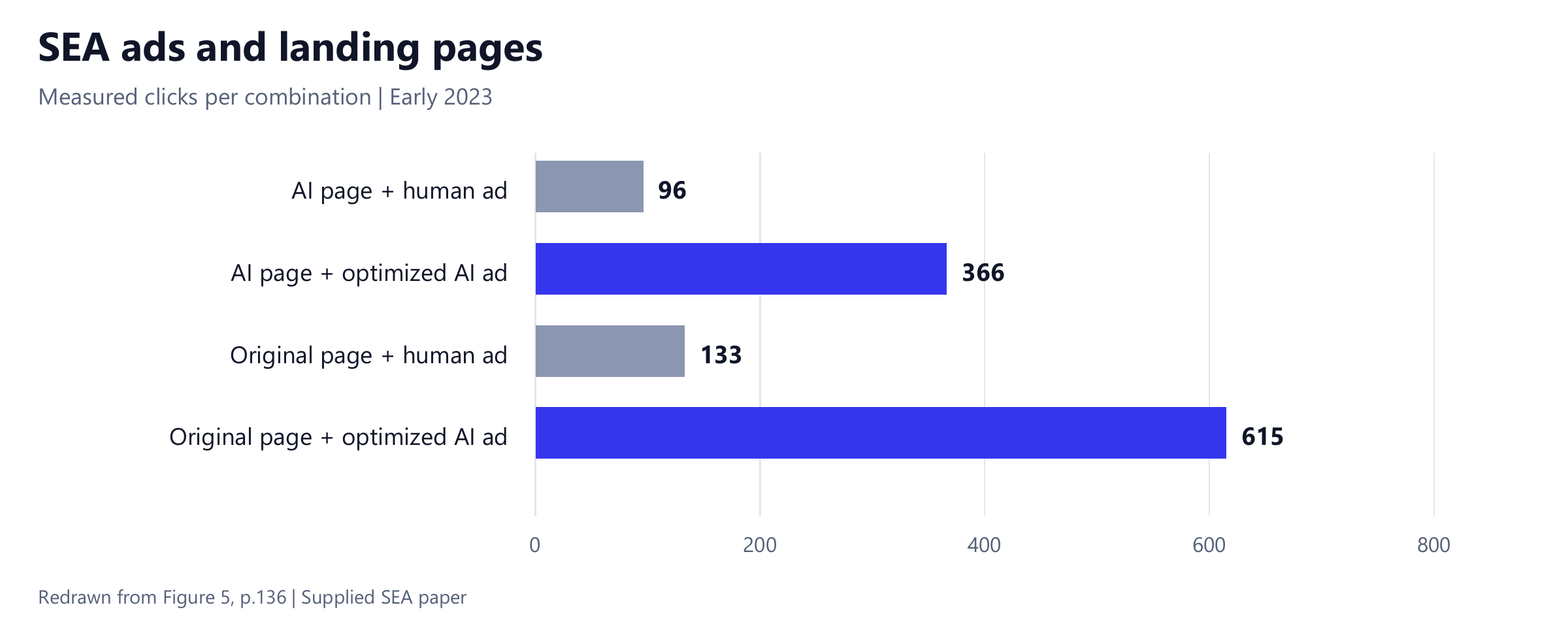
Iphos also tested four combinations of ad copy and landing-page content across 18 keywords, with a EUR 50 daily campaign cap. Optimized AI ads outperformed human ads with both landing-page types. The strongest combination in this trial was optimized AI ads with the original human-written landing page.
| Landing page / ad content | Impressions | Clicks | Est. conv. | Median CPC |
|---|---|---|---|---|
| AI / SEO-optimized / Human keyword-specific | 2,653 | 96 | 2 | EUR 0.29 |
| AI / SEO-optimized / Optimized AI + expert review | 8,738 | 366 | 7 | EUR 0.29 |
| Original human-written / Human keyword-specific | 2,506 | 133 | 3 | EUR 0.27 |
| Original human-written / Optimized AI + expert review | 13,114 | 615 | 12 | EUR 0.30 |
Figure 5, p.136, redrawn from the reported counts. This trial supports testing the full ad-to-page journey: changing both elements together did not produce the best outcome here.
Keeping cost per click in view
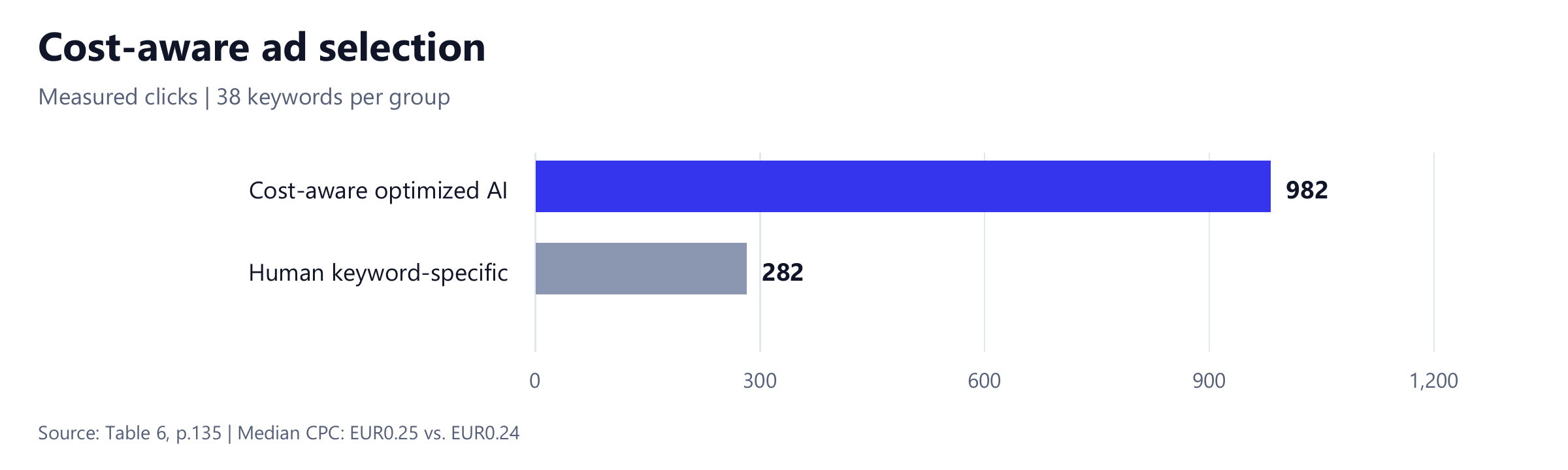
In a separate 38-keyword trial, the workflow selected ads with lower predicted bidding costs. This produced 982 clicks versus 282, while median CPC remained close to the human-written baseline: EUR 0.25 versus EUR 0.24.
| Ad content | Impressions | Clicks | Est. conv. | Median CPC |
|---|---|---|---|---|
| Cost-aware optimized AI + expert review | 24,205 | 982 | 18 | EUR 0.25 |
| Human keyword-specific | 6,476 | 282 | 6 | EUR 0.24 |
Table 6, p.135. Approximately one month in early 2023; shared daily campaign cap EUR 40. The maximum observed CPC was EUR 0.39 for optimized AI ads and EUR 3.28 for human ads. These are trial observations, rather than guaranteed CPC limits.
Less production effort
Across the study's shared 208-ad workflow, the authors reported substantial production savings. This illustrates the operational value of generating and selecting campaign copy before expert review.
| Shared workflow result | Reported saving |
|---|---|
| Production effort | More than 60% efficiency gain |
| Time to produce 208 ads | 19.17 hours saved |
| Production cost calculation | EUR 551 saved |
Section 4.1, p.132. These are pooled workflow calculations, rather than an Iphos-specific cost audit. The paper did not report a separate readability score for this SEA case.
More productive SEA campaigns
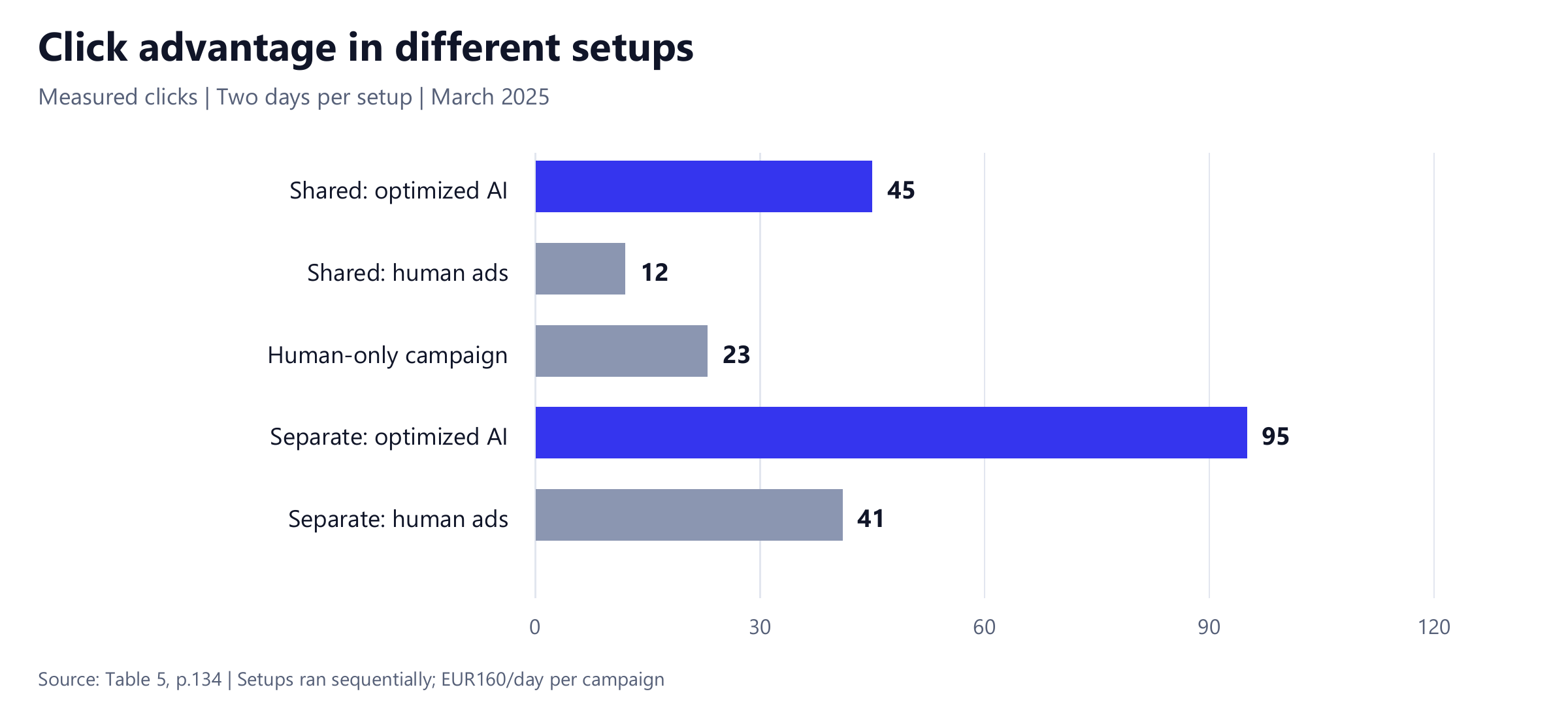
The click advantage also appeared when campaign structure changed. A March 2025 follow-up compared a shared campaign, a human-only campaign and separate simultaneous campaigns. Each setup ran for two days; each campaign had a EUR 160 daily cap.
| Campaign setup | AI impr. | Human impr. | AI clicks | Human clicks |
|---|---|---|---|---|
| Shared campaign | 1,756 | 218 | 45 | 12 |
| Human-only campaign | N/A | 1,190 | N/A | 23 |
| Separate simultaneous campaigns | 2,522 | 1,281 | 95 | 41 |
Table 5, p.134. Setups ran sequentially; the separate setup had two campaigns, each with its own cap. Their combined budget should not be treated as equal to the shared campaign budget.
For Iphos, the practical result was a repeatable way to improve paid-search visibility and traffic while keeping editorial review and cost-aware selection in the workflow.
Source: Reisenbichler, Reutterer and Schweidel (2026), Applying Large Language Models to Sponsored Search Advertising, Marketing Science 45(1), 123–141. DOI: 10.1287/mksc.2023.0611. Figures and tables are adapted from the supplied paper. Partner names were supplied by the client. These trials demonstrate the approach behind LastLayer; results depend on campaign, content and market conditions.