

We worked with WU Vienna to improve the Google performance of 30 pages on wu.ac.at. Using the SEO approach behind LastLayer, we replaced existing expert-written copy with content guided by current search results and reviewed by university staff. The project delivered an approximately threefold ranking improvement and increased the number of pages appearing in Google's top 10.
Results at a glance
- Approximately 3× ranking improvement compared with the previous expert-written content.
- 30 pages optimized for keywords relevant to the university's education offering.
- More pages in Google's top 10, improving visibility where prospective students search.
- Around four months of performance monitoring, covering the period before and after the content change.
- 1.3 hours of editorial work per page, with staff typically changing only about 10% of the generated text.
The challenge
WU's website already used content produced by an SEO expert. The next step was to improve its search performance further and make information about its education offering easier to discover, while keeping university staff involved in the final content review.
Our approach
We used current Google results for each target keyword to guide the creation and evaluation of new page content. Two university employees reviewed and revised the selected drafts before replacing the existing copy on the same pages.
This gave WU a focused editorial workflow: staff worked from prepared drafts and made the changes needed for publication, rather than writing each page from the beginning.
The outcome
After the content was updated, the pages achieved better average Google rankings and more top-10 placements than the previous expert-written versions. Rankings were monitored for 30 days before the change and 96 days afterwards, showing the improvement over a sustained period.
The editorial effort remained manageable. Staff spent a median of 1.3 hours reviewing each page and changed roughly one tenth of the generated wording, retaining responsibility for the published content.
Google visibility before and after optimization
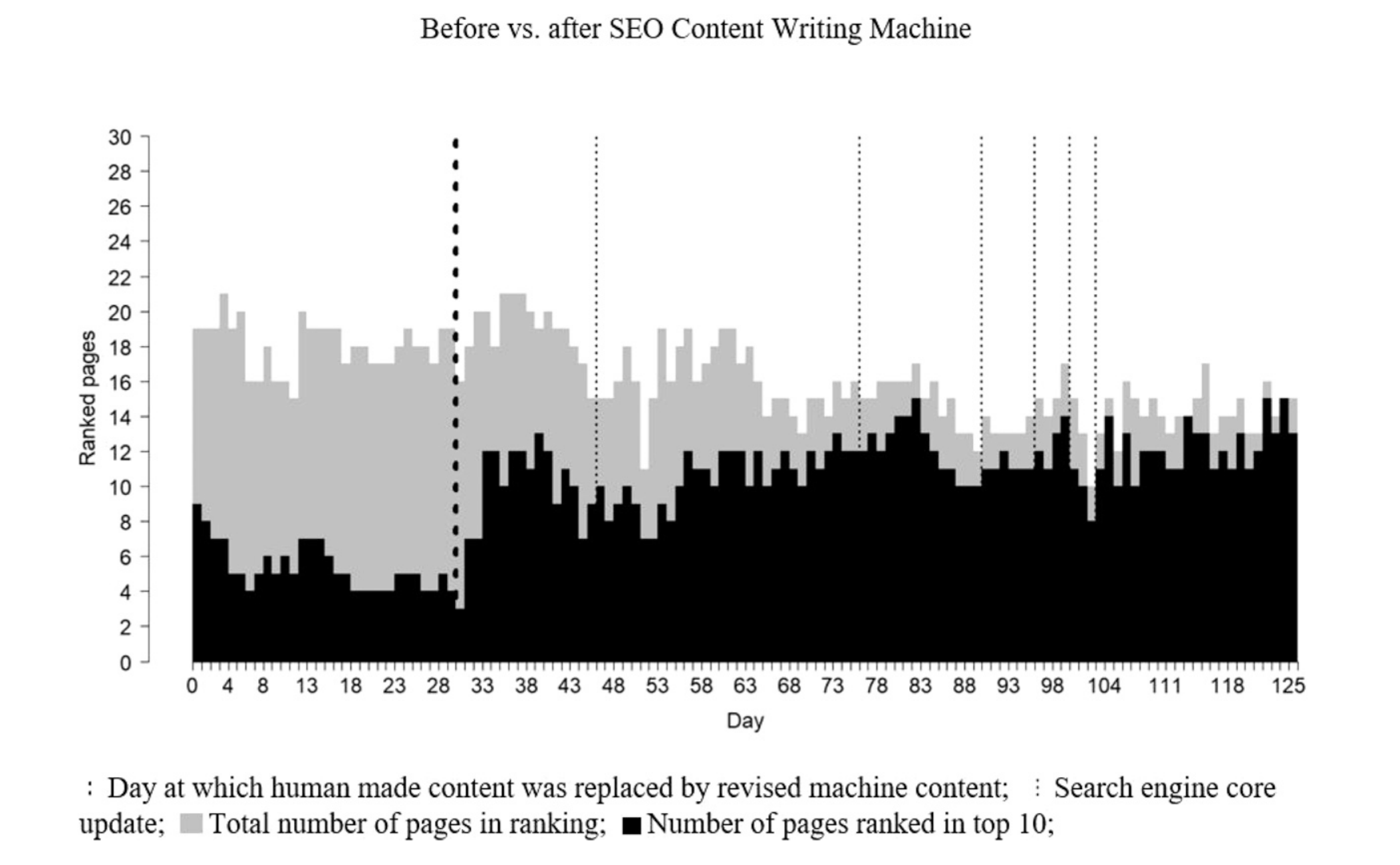
More pages reached Google's top 10 after the content was updated. The bold vertical marker around day 30 identifies the change from the previous expert-written copy to reviewed AI content. The grey series shows the total number of pages in the monitored rankings, and the black portion shows the subset in the top 10. The finer dotted lines mark Google core updates.
Original graph: Figure 5, paper page 451. The black portion becomes consistently larger after the update, showing greater first-page visibility. This is a change in the quality of ranking positions; it does not mean that the total number of ranked pages increased.
Project results
| Measure | Reported result |
|---|---|
| Website pages updated | 30 |
| Content comparison | Previous SEO expert-written copy versus AI content reviewed by university staff |
| Google ranking outcome | Better average rankings and more pages in the top 10 after the update |
| Baseline monitoring | 30 days before the content change |
| Monitoring after the update | 96 days |
Summary of the education-sector results reported on paper page 449 and illustrated in Figure 5. The paper describes these results in the text rather than in a separate numbered table.
Editorial effort
| Measure | Reported result |
|---|---|
| University staff reviewing the content | 2 |
| Median review and revision time per page | 1.30 hours / 78 minutes |
| Median share of generated wording changed | 10.51% |
| Median number of words changed per page | 83 |
Figures reported on paper page 449. The time and editing figures are medians across the 30 pages. The paper does not report a WU-specific monetary saving or a separate reader-rating evaluation.
For WU Vienna, the project demonstrated how search-informed content optimization can improve the performance of an established website. It created more opportunities for prospective students to find relevant university information through organic search, with a workflow centred on staff review and refinement.
Source for the graph and detailed result tables: Reisenbichler, Reutterer, Schweidel and Dan (2022), Frontiers: Supporting Content Marketing with Natural Language Generation, Marketing Science 41(3), 441–452. The original graph is reproduced, and the tables summarize the reported findings. The approximately 3× headline figure comes from the supplied website brief; the paper reports better average rankings and more top-10 placements without stating that multiplier.