


We worked with Iphos IT Solutions GmbH to make its service content more visible in Google and more efficient to produce. Using the SEO approach behind LastLayer, AI-generated content was evaluated against current search results and refined by a company editor before publication. The resulting pages outperformed manually written content in organic search, while requiring substantially less production time.
Results at a glance
- 17 of 19 optimized pages ranked on a typical day, compared with 2 of 9 pages written by professional SEO writers.
- 7 pages reached Google's top 10 on a typical day, compared with none in the professional SEO group.
- Around 91% lower estimated total production costs, from approximately €273 to €24 per page.
- 33 minutes of editorial work per page, compared with 9.5 hours in the company's existing manual process.
- Comparable readability, clarity and credibility to human-written content in reader evaluations.
The challenge
Creating SEO content required extensive research and writing. Iphos needed a more efficient way to produce relevant service pages that could compete in Google and communicate clearly with potential customers.
Our approach
For 19 target keywords, we used current search results to guide content generation, evaluate drafts and select the strongest text for each page. A company employee then reviewed and refined the content for accuracy and fit with the business.
The pages were published alongside content created by professional SEO writers, trained non-professionals and novices. Their Google performance was tracked for 412 days, providing a comparison over more than a year.
The outcome
The optimized pages achieved stronger and more consistent search visibility than all three human-writing groups. Their performance also extended to related search terms. Higher visibility was accompanied by more page views and more website sessions starting through the SEO content.
Reader evaluations found no meaningful differences in readability, understandability, credibility or naturalness between the edited AI content and human-written texts. The company editor remained an essential part of the process, checking the content before it reached customers.
Google visibility over time
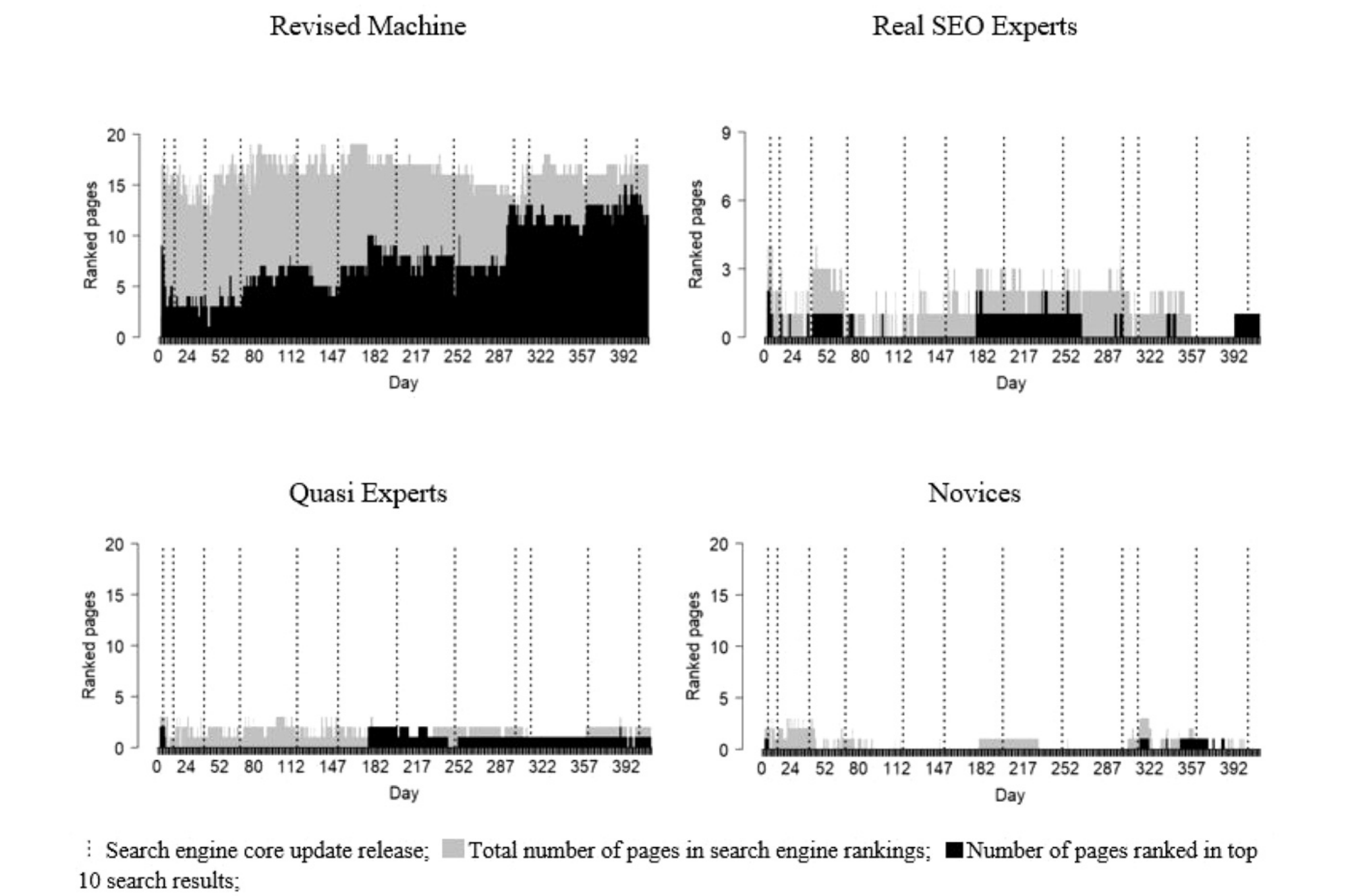
The optimized content maintained stronger visibility over more than a year. The grey series shows the total number of pages in the monitored Google results; the black portion shows the subset in the top 10. Dotted vertical lines mark Google core updates. In the original graph, "Revised Machine" means AI content reviewed by a company editor, and "Quasi Experts" means trained non-professional writers.
Original graph: Figure 4, paper page 447. Each group produced 19 pages, except the professional SEO group, which produced 9. The panel scales reflect those different group sizes.
Ranking results
| Content approach | Pages evaluated | Pages ranking on a typical day | Pages in Google's top 10 on a typical day |
|---|---|---|---|
| Optimized AI content with company review | 19 | 17 | 7 |
| Professional SEO writers | 9 | 2 | 0 |
| Trained non-professional writers | 19 | 2 | 1 |
| Novice writers | 19 | 0 | 0 |
Adapted from Table 2, paper page 448. Daily counts are medians across 412 observation days. "Ranking" refers to Google's top 300 results; top 10 is the subset with first-page positions.
Production time and cost
| Measure | Iphos's existing manual process | Optimized AI content with company review |
|---|---|---|
| Median human work per page | 9.5 hours | 0.55 hours / 33 minutes |
| Estimated total production cost per page | €272.81 | €23.94 |
| Estimated annual output at an approximately €45,000 budget | 165 pages | 1,880 pages |
| Estimated cost to produce 165 pages | Approximately €45,000 | Approximately €3,949 |
Around 94% less human work and 91% lower estimated total costs per page. The time saving comes from moving research and drafting into the automated workflow, while retaining company review.
Adapted from Table 4, paper page 450. Costs and annual capacity are estimates based on recorded work times and the paper's salary, working-time and system-cost assumptions. The optimized process includes labour, server, maintenance and allocated development costs. The manual baseline here is the company's existing process, rather than the separate professional-writer comparison group above.
Reader perceptions
| Reader rating | Optimized AI content with company review | Professional SEO content |
|---|---|---|
| Readability | 3.81 | 4.06 |
| Understandability | 3.34 | 3.54 |
| Credibility | 3.88 | 3.99 |
| Naturalness | 3.23 | 3.49 |
Selected results from Table 3, paper page 448. Scores are average ratings on a scale from 1 to 5, where higher is better. Across the writing groups, the paper found no statistically significant differences on these four dimensions. The evaluation included 551 usable reader responses.
For Iphos, the project demonstrated a practical way to expand SEO content production with less manual effort and a much lower estimated cost per page.
Ranking counts and work times are daily medians and median production times respectively. Rankings were monitored within Google's top 300 results. Cost savings are estimates against the company's existing process and include labour, development and operating costs.
Source for the graph and result tables: Reisenbichler, Reutterer, Schweidel and Dan (2022), Frontiers: Supporting Content Marketing with Natural Language Generation, Marketing Science 41(3), 441–452. The original graph is reproduced; the tables retain the reported results with simplified labels and without mathematical or statistical test details.