

WU Vienna tested the performance-focused SEA approach behind LastLayer to reach prospective students with ad copy tailored to their searches. The workflow combined AI generation with search and landing-page context, then used expert review to prepare the selected ads for launch.
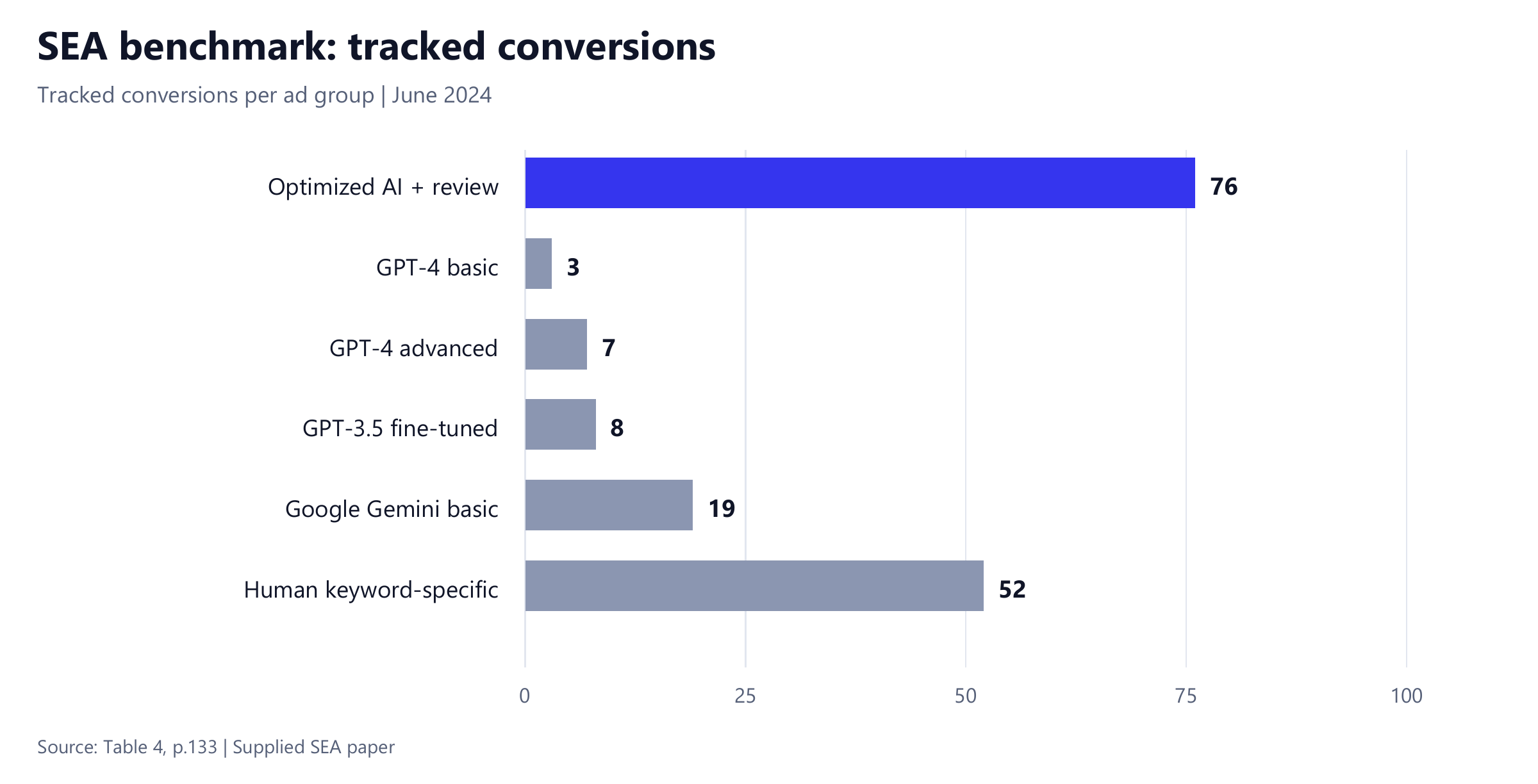
In the June 2024 benchmark, optimized AI ads generated 76 tracked conversions, compared with 52 for human-written keyword-specific ads. They also delivered more impressions and clicks, helping the university reach more potential students through paid search.
SEA results for student acquisition
The university needed keyword-specific search ads that connected prospective students' search intent with relevant programme information. The workflow generated and evaluated alternatives for each target keyword, with SEA experts reviewing the selected copy before launch.
Six approaches were compared over one month in June 2024, with 19 keywords per group and a shared daily campaign cap of EUR 40. The optimized group achieved the highest tracked conversion count of the tested approaches.
| Ad content | Impressions | Clicks | Tracked conv. | Median CPC |
|---|---|---|---|---|
| Optimized AI + expert review | 24,645 | 3,598 | 76 | EUR 0.11 |
| GPT-4 basic prompting | 261 | 41 | 3 | EUR 0.09 |
| GPT-4 advanced prompting | 17,244 | 2,192 | 7 | EUR 0.11 |
| GPT-3.5 fine-tuned | 9,256 | 1,063 | 8 | EUR 0.12 |
| Google Gemini basic prompting | 7,890 | 1,255 | 19 | EUR 0.11 |
| Human keyword-specific | 18,882 | 3,200 | 52 | EUR 0.10 |
Table 4, p.133. Conversions in this WU benchmark were tracked. Impressions and clicks are summed counts; CPC is the median across ads and keywords. Shared campaign budgets do not imply equal spend per ad group.
The increase from 52 to 76 tracked conversions is the clearest commercial outcome: 24 additional conversions, or a 46% uplift, compared with the human-written keyword-specific baseline. Conversion events were recorded by the campaign; the paper does not equate them with confirmed student enrolments.
More exposure and more clicks contributed to the result. The median CPC was slightly higher for optimized AI ads, so this trial demonstrates increased campaign outcomes rather than a reduction in the price of each click.
A repeatable, more efficient SEA workflow
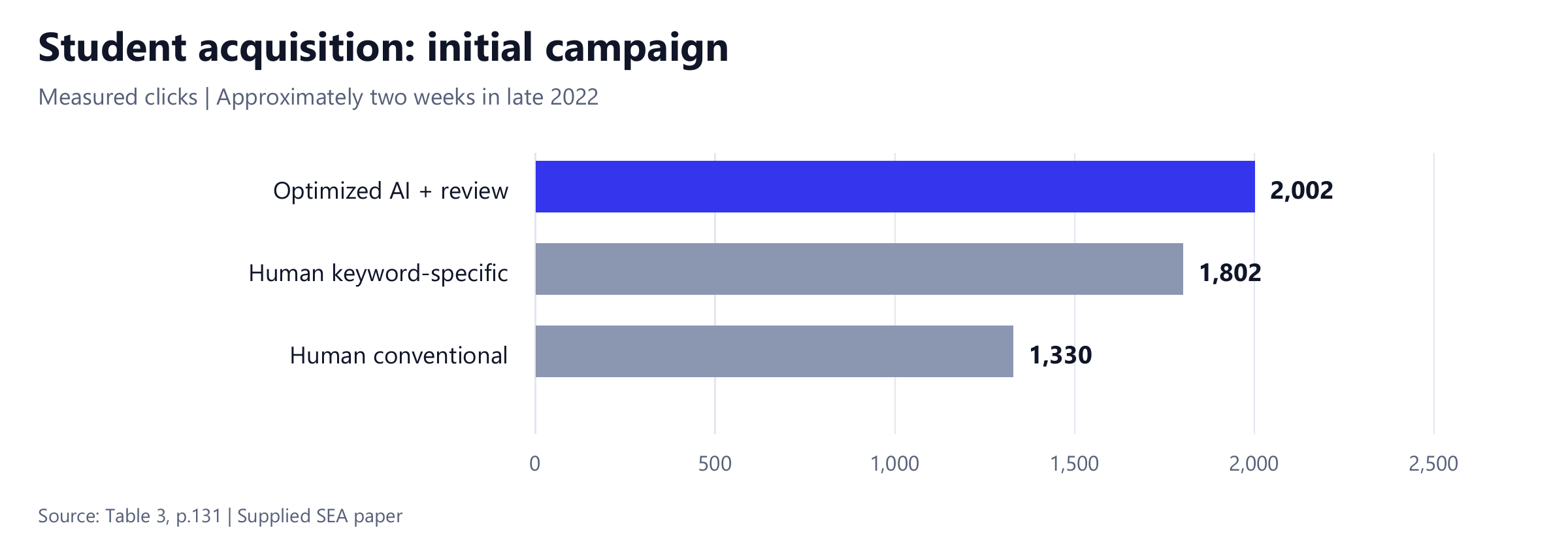
An earlier student-acquisition campaign in late 2022 provided a second comparison with human-written ads. Over approximately two weeks, with a shared daily cap of EUR 165, optimized AI ads again generated the most impressions and clicks.
| Ad content | Impressions | Clicks | Est. conv. | Median CPC |
|---|---|---|---|---|
| Optimized AI + expert review | 21,252 | 2,002 | 153 | EUR 0.50 |
| Human keyword-specific | 17,374 | 1,802 | 138 | EUR 0.49 |
| Human conventional | 9,741 | 1,330 | 106 | EUR 0.56 |
Table 3, p.131. Conversion tracking was unavailable in this earlier campaign, so its conversion figures are estimates. Optimized AI ads achieved 11% more measured clicks than the keyword-specific human baseline and 51% more than conventional human ads.
Faster campaign content production
The workflow gives the marketing team a structured route from target keyword to reviewed ad copy. Across the study's shared 208-ad production exercise, the authors reported the following savings:
| Shared workflow result | Reported saving |
|---|---|
| Production effort | More than 60% efficiency gain |
| Time to produce 208 ads | 19.17 hours saved |
| Production cost calculation | EUR 551 saved |
Section 4.1, p.132. These are pooled workflow estimates, rather than a separate WU cost audit. A budget follow-up also reported a consistent performance advantage under alternating EUR 40 and EUR 5 daily caps; detailed counts are not provided in the main paper.
For WU Vienna, the case demonstrates how AI-supported content selection can improve paid-search outcomes while retaining expert oversight. The workflow reduces the effort of producing many keyword-specific ads and gives marketers a clearer basis for selecting content to test.
Source: Reisenbichler, Reutterer and Schweidel (2026), Applying Large Language Models to Sponsored Search Advertising, Marketing Science 45(1), 123–141. DOI: 10.1287/mksc.2023.0611. Figures and tables are adapted from the supplied paper. Partner names were supplied by the client. These trials demonstrate the approach behind LastLayer; results depend on campaign, content and market conditions.