


searchit tested the GEO approach behind LastLayer across 24 target prompts and landing pages. The team replaced existing pages created with human involvement and GPT with content generated and optimized specifically for visibility in GPT-5.1.
The result: top-10 entries increased from 26 to 54, more than doubling the recorded visibility in the target engine. Total recorded GPT-5.1 ranking entries rose from 43 to 74, while Google visibility also increased.
Ranking totals combine four weekly observations before and four after optimization. They count recorded entries across those observations, rather than unique pages.
Content built for visibility in AI answers
searchit wanted its content to appear more often when prospective customers asked GPT about relevant IT and search topics. The existing pages already used GPT-assisted content with an SEO workflow directed at Google. The experiment tested what changed when the content was optimized for the target generative engine.
The team evaluated the content appearing for each target prompt, generated alternatives and selected an optimized page text for each of the 24 prompts. The new texts replaced the existing page content after week 4. The team then allowed time for the engines to index the changes before measuring the follow-up results.
More recorded visibility in GPT-5.1
| Visibility measure | Before | After | Change |
|---|---|---|---|
| GPT-5.1 top-10 entries | 26 | 54 | +108% |
| GPT-5.1 all ranking entries | 43 | 74 | +72% |
| Google top-10 entries | 44 | 70 | +59% |
| Google all ranking entries | 53 | 83 | +57% |
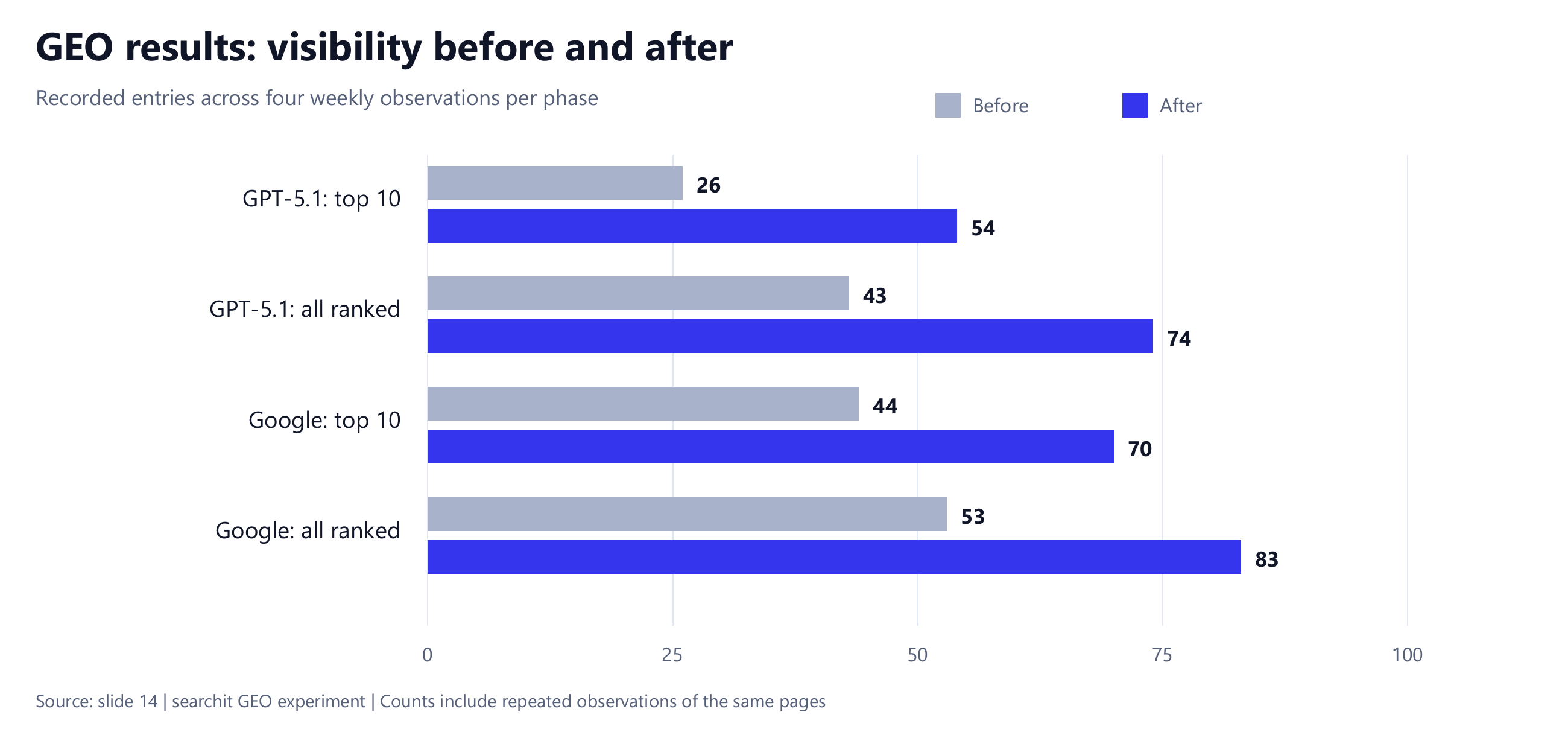
Source: slide 14. The comparison uses weeks 1–4 before the content replacement and weeks 10–13 after indexing. Changes are rounded from the reported counts.
For GPT-5.1, the deck reports improvements in ranking positions as well as visibility counts. For Google, it reports more ranked entries and more top-10 entries, while the change in ranking positions was not significant. The clearest result is the increase in opportunities for searchit's pages to appear in the target engine's results.
The ranking results over time
The weekly results show how visibility developed before and after the replacement. GPT-5.1 top-10 counts rose from 5–8 per baseline observation to 13–15 per follow-up observation. All four follow-up observations were above the baseline range.
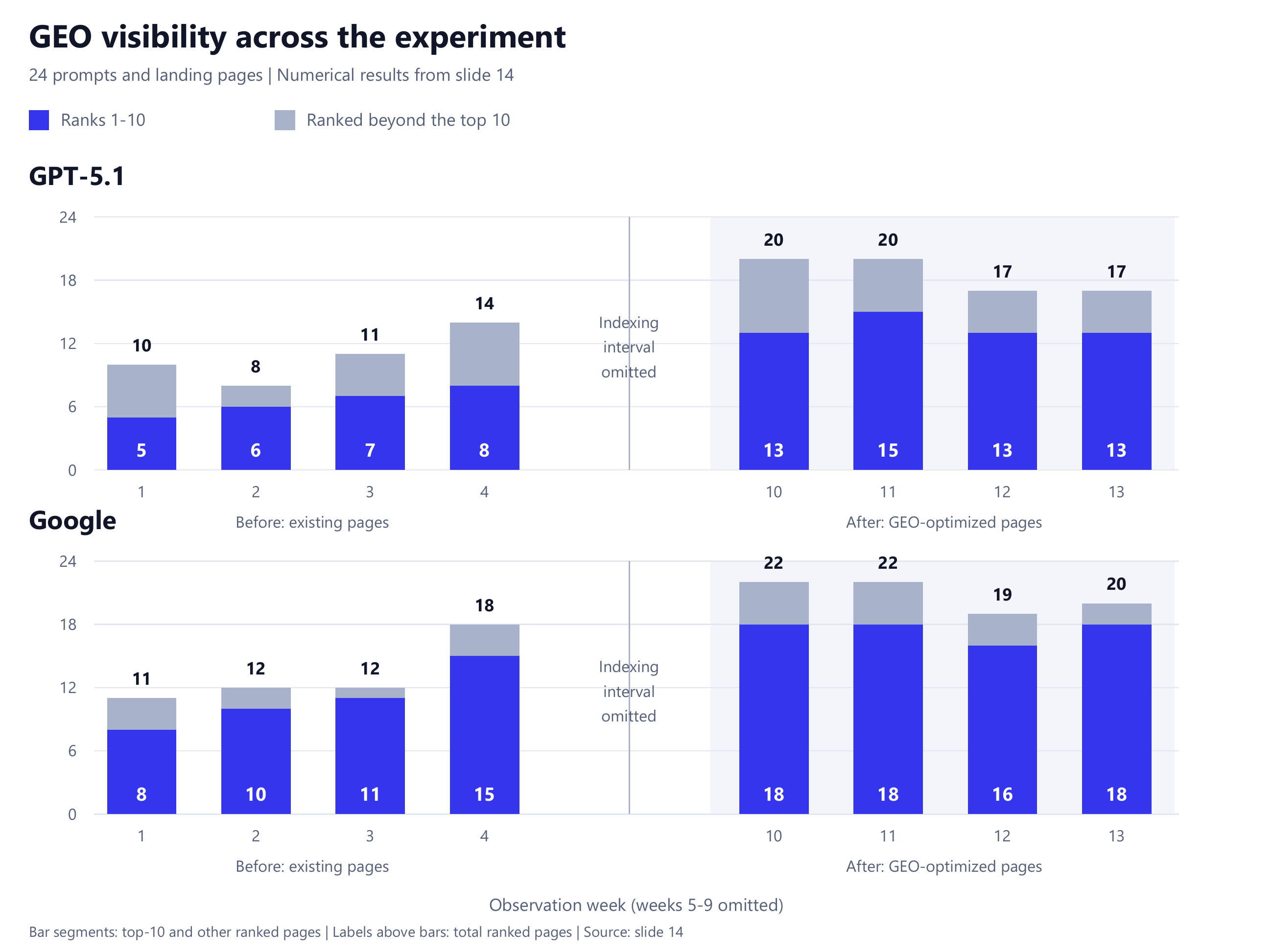
| Week | GPT-5.1 top 10 | GPT-5.1 all ranks | Google top 10 | Google all ranks |
|---|---|---|---|---|
| 1 | 5 | 10 | 8 | 11 |
| 2 | 6 | 8 | 10 | 12 |
| 3 | 7 | 11 | 11 | 12 |
| 4 | 8 | 14 | 15 | 18 |
| 10 | 13 | 20 | 18 | 22 |
| 11 | 15 | 20 | 18 | 22 |
| 12 | 13 | 17 | 16 | 19 |
| 13 | 13 | 17 | 18 | 20 |
Source: slide 14. The indexing interval (weeks 5–9) is omitted from the chart and the before/after totals. Bar labels show the printed numerical results from the source slide.
Readable content and results across engines
The selected GEO content also performed well in automated content evaluation. The deck compares it with pages already appearing in GPT-5.1's top 10. It reports stronger readability and more natural writing, alongside higher relevance scores.
| Automated content measure | Selected GEO content | GPT-5.1 top-10 reference |
|---|---|---|
| Readability | 0.866 | 0.610 |
| Natural writing style | 0.806 | 0.593 |
| Topic alignment | 0.443 | 0.331 |
| Uniqueness | 0.974 | 0.941 |
Source: slide 13. These are mean automated scores. The comparison uses ranked reference pages, rather than the replaced searchit pages or reader-survey ratings.
The wider visibility picture
The target was GPT-5.1. The team also recorded results for other engines to assess how widely the changes carried over.
| Platform | Top 10 before | Top 10 after | All ranks before | All ranks after |
|---|---|---|---|---|
| GPT-4o / GPT-5.2 | 31 | 51 | 44 | 72 |
| Bing | 45 | 50 | 63 | 68 |
| Perplexity | 41 | 52 | 41 | 52 |
| Copilot | 69 | 64 | 73 | 71 |
| Google AI mode | 8 | 14 | 12 | 17 |
Source: slide 15. GPT-4o / GPT-5.2 is the combined label used in the deck. Its visibility counts improved significantly in the reported tests. Changes for Bing, Perplexity, Copilot and Google AI mode were not significant.
For searchit, the experiment demonstrates the commercial value of optimizing website content for a defined generative engine. It created more recorded opportunities to appear in GPT-5.1 while preserving visibility in Google. The reported outcomes concern visibility and content quality; the slides do not quantify traffic, sales or production savings.
Source: client experiment presentation, slides 13–15. Partner identity and the human-plus-GPT baseline were supplied by the client. This is a before/after field experiment with an indexing interval; the deck does not show a concurrent untreated control group. Results depend on the model, prompts, content and observation period.